A few days ago, I finished the first draft of a novel I began writing in April under the tutelage of Lori Wilde in her Novel in Six Months Class at SavvyAuthors. It came in at around 77,000 words. Now mentally exhausted and physically drained, I took the entire weekend off to reboot my weary self. Four romantic comedies and one Jane Austenesque book later, I found myself (as I sipped cold sparkling water in my back yard while reclining with aforementioned book) becoming introspective about the crazy life writers lead.
--Writing the climax of this book-in-progess of mine was the most agonizing thing I have ever done. I could not sleep until I got my hero and heroine out of crisis and tucked safely into their happily-ever-after. It took about a week for me to navigate those tricky scenes and I was mentally and physically affected. An example: my daughter asked me a question while I was furiously typing away and I mumbled an answer...and then she asked, "Mom, why did you just answer me in a British accent?!" The characters in my head were coming out to torment the rest of my life!
--Author Steve Berry, when he spoke at RWA in NYC earlier this summer, said something really interesting. He said (and this is from scrawls in my little notebook--so it's a paraphrase)--Every writer he's ever known has a little voice in their head. I have known about my little voice for quite some time now. But this was a revelation! Someone was actually admitting this out loud! On observing someone or something, the voice says particular things like, she cast her weary eyes downward or her skirt pouffed out like a skein of cotton candy at the most unexpected times. What a relief to know that others hear The Voice, too!
--What caused all this reflection was a passage in the book I am currently reading, A Weekend with Mr. Darcy by Victoria Connelly. The book is about an English professor who's secret passion is reading Regency romance novels, especially ones by a particular favorite author. (You can read more about this charming book here--this review made me instantly download the book.) Anyway, the author character in the book makes this revelatory comment about writers (here's a bit of a setup before the comment for context):
"Warwick watched her as she looked around the hall, tiny white teeth biting her lower lip, and a part of him wanted to go help her--to take her bag and say, 'Come this way,' but the writer in him stayed perfectly still and watched.
That was one of the things about being a writer--one always stood slightly apart, listening and watching. It was hard to tell sometimes, if one were really alive, for life seemd to be happening to everybody else, and yet the writer's lot seemed to be one of permanent stillness. Had Jane Austen felt like that? he wondered."
So, do you get emotionally involved with imaginary people in your head? Have difficulties with the voice that rambles around in there at the most inappropriate times? Or find yourself observing and imbibing the details of life, sort of voyeuristically? You may not need Haldol after all...you just might be a Writer.

Sunday, July 31, 2011


Wednesday, July 13, 2011
Keeping the Reader in the Story--Advice from Susan Elizabeth Phillips at RWA 2011
[Today I thought I'd share with you an article I wrote for the July issue of my local chapter newsletter.] [Wasn't Nationals fun?!]
Susan Elizabeth Phillips, bestselling author of contemporary romance, gave a talk to a packed room at RWA Nationals on “Writing the Bestseller: Six Magic Words.” She was highly entertaining and hilarious and packed a wealth of knowledge into this talk.
What makes a great read so compelling the reader can’t put it down? Either the plot is so riveting, or you care about the characters so much you can’t stop reading, or the author is showing you something you’ve never seen before.
Susan cautioned that writing a compelling book is not the same as writing the perfect book, which she defined as a book where you follow all the rules.
You’ve got to KEEP THE READER IN THE STORY (those are the six magic words). Anything that pulls the reader out—DON’T DO. So here are FOUR tips to keep the reader in the story:
1. Work to master good craft.
Lack of mastery of grammar, use of repetitive words, awkward sentence structure, and clunky use of research will lose your reader. She is not a purist about POV shifts but if the reader notices, shame on you. Master your craft before you break the rules.
She gives herself permission to “put garbage on the screen,” knowing at some point she’s going to have to go back and correct a lot of things. If you’re a perfectionist, leave your perfectionism behind!
2. Keep the reader in the story by creating dazzling characters, ones we cannot bear to be parted from. You want to get an emotional reaction from your reader. This means that your characters are sympathetic BUT NOT PERFECT. You can give your characters lots of flaws if you keep their heart pure. Characters in popular fiction should be realistic but still LARGER THAN LIFE. (Susan got a huge laugh when she joked that this is unlike literary fiction, which mimics life—“which is why it’s so damn boring.”)
Characters must have well-motivated actions. Don’t sacrifice character just to move your plot forward. Rather, keep your plot moving forward by giving your characters strengths and weaknesses. Let your characters grow throughout the story so that by the end, they are able to do something that they couldn’t at the beginning.
Give them strong individual voices. Nail each scene emotionally. When you’re done, go back and read only the scenes with the heroine in them all the way to the end—then go back and do this for the hero. Then you will be able to chart their relationship and their relationship with all the other characters in every scene.
3. Create a fast-moving plot. It’s easy—just LEAVE OUT THE BORING PARTS. You can write them, just cut them out before the end. This means backstory, research, any character staring out the window, too much internal dialogue, etc. Weave in backstory as seamlessly as possible and in bits and pieces.
End chapters on a cliffhanger. If the scene has a resolution that would make the reader stop and go to bed, bury it in the middle of the chapter.
Subplots should begin after the main story and end before it. If the main plot runs out of steam, she switches to the subplot to mix it up.
Raise stakes as high as possible. She takes out a yellow pad and writes AND THEN THINGS GET WORSE and then brainstorms all the possibilities, writing down anything and everything that comes to mind.
4. Keep the reader in the story by writing to your strengths, not just the market. Feedback from readers can help identify your strengths. Use critique groups carefully. She has found that being critiqued while she is in process doesn’t work for her—so she waits until she has a finished product to share. She said you do what you have to do to produce and you have to get tough about protecting your work. So you have to find the method that works best for you.
This was a great talk—the best I heard at Nationals. If you get a chance to listen to it when the disc comes out, I highly recommend it. Oh, and if you haven't already, you can find Susan Elizabeth Phillips at susanephillips.com.
Monday, June 27, 2011
I had to go to France to find an English Garden
I just came back from the family vacation of a lifetime and wanted to share this with you...and then I promise, I will stop talking about gardens!
We went to France, even though, alas, I of course wanted to go to England. But with two teens who have taken years of French, France won out. (That's okay, some day it will be Regency England tour without the teens!)
Below is a picture of the very French gardens at the palace of Versailles, outside of Paris. Notice the geometrical lines, the regularity imposed on the disorder of nature, which indicted how the king had the power to impose his will on his vast kingdom. (The source on this is here, a PBS link, but the picture is mine.)
![]()
The long sight lines are a metaphor for the king's power, which extends in all directions, as far as the eye can see.
![]()
But just around the corner (okay, these gardens are pretty vast, so farther than that) is Marie Antoinette's Hamlet (the "Hameau de la Reine") which was her private retreat in the park of the palace built around 1785-92. This retreat was complete with rustic buildings and was a real working farm. It has a pond and a windmill and various little buildings. But the best part, at least for me, is that it has an English garden!
![]()
Notice the meandering gravel paths that wind around the sights,
![]() the benches that offer a place to admire the view or to reflect on the scenery...
the benches that offer a place to admire the view or to reflect on the scenery...
![]()
And here's the requisite folly--the classical Temple of Love, with Cupid in the middle.
![]()
From far away, it looked really small.
![]()
![]()
Here are some shady characters crossing a little bridge.
![]() The paths, just as in Jane Austen's day, were quite wide, condusive to talking and walking.
The paths, just as in Jane Austen's day, were quite wide, condusive to talking and walking.
![]()
But the best part of all was the ha-ha wall. (Another shady character standing atop that!)
So you can really tell a difference between the winding paths and broken vistas of the English garden vs. the linearity and expansiveness of the French one. Voila!
Next stop for me is RWA Nationals! See you all there!
We went to France, even though, alas, I of course wanted to go to England. But with two teens who have taken years of French, France won out. (That's okay, some day it will be Regency England tour without the teens!)
Below is a picture of the very French gardens at the palace of Versailles, outside of Paris. Notice the geometrical lines, the regularity imposed on the disorder of nature, which indicted how the king had the power to impose his will on his vast kingdom. (The source on this is here, a PBS link, but the picture is mine.)

The long sight lines are a metaphor for the king's power, which extends in all directions, as far as the eye can see.
But just around the corner (okay, these gardens are pretty vast, so farther than that) is Marie Antoinette's Hamlet (the "Hameau de la Reine") which was her private retreat in the park of the palace built around 1785-92. This retreat was complete with rustic buildings and was a real working farm. It has a pond and a windmill and various little buildings. But the best part, at least for me, is that it has an English garden!

Notice the meandering gravel paths that wind around the sights,


And here's the requisite folly--the classical Temple of Love, with Cupid in the middle.

From far away, it looked really small.


Here are some shady characters crossing a little bridge.


But the best part of all was the ha-ha wall. (Another shady character standing atop that!)
So you can really tell a difference between the winding paths and broken vistas of the English garden vs. the linearity and expansiveness of the French one. Voila!
Next stop for me is RWA Nationals! See you all there!
Monday, June 6, 2011
In the Garden with Jane Austen: Part 2, The Shrubbery
I promised to take you on a tour of an English shrubbery, as Kim Wilson describes it in her beautiful book In the Garden with Jane Austen. (Please see my last post if you want more information about the book.)

The English garden was built to be experienced by walking through it and discovering surprising elements--vistas, benches, follies, grottoes, etc.
The English garden was built to be experienced by walking through it and discovering surprising elements--vistas, benches, follies, grottoes, etc.
For now, just imagine that you are a Regency heroine, and you are spending time at your family’s great country estate. You’d like the health benefits of a daily constitutional, but it’s rained recently and the countryside has turned into a muddy quagmire (channel Keira Knightly as Elizabeth trapsing through the mud to see her sick sister Jane at Bingley’s estate) You don’t dare get wet, knowing that wet feet could kill a person, especially a woman with her flimsy shoes and (arguably) more fragile constitution. What to do?

Garden path in a Regency shrubbery.
Well, the architect of your estate has done something just for you. He (she?—I hope there were some “she” architects) has created for you the shrubbery, that fantastic, carefully arranged walk that will lead you through a variety of carefully arranged gardens, trees, shrubs, all with quick-draining gravel and long enough for you to get some real exercise. (It was a great relief for me to learn that there actually was “gravel” back then. I get tired of writing about cobblestones. :) )
These walks were sometimes wide enough to accommodate three people astride. Wilson Elizabeth
“...each walk should lead to a particular Object; to the orchard, kitchen garden, botanical borders, green-house, dairy, ice-house, mushroom-hut, aviary, poultry-yard, or stables. The intention of the plantation should seem to be, to conduct the walker in the most agreeable manner to each outlet and building of utility or pleasure.”
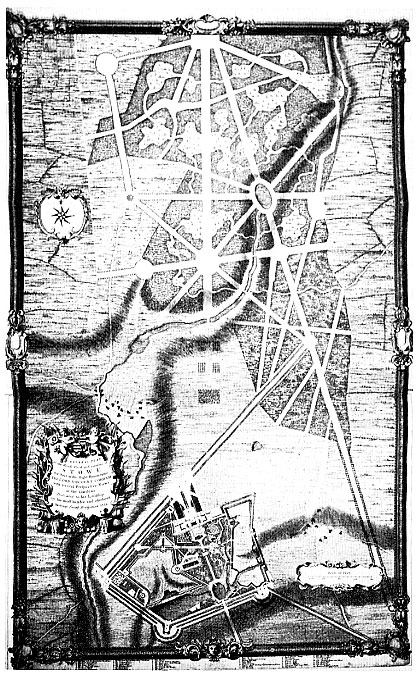
Look how extensive the original plan of Stowe Garden (Buckinghamshire, England) was in 1739.
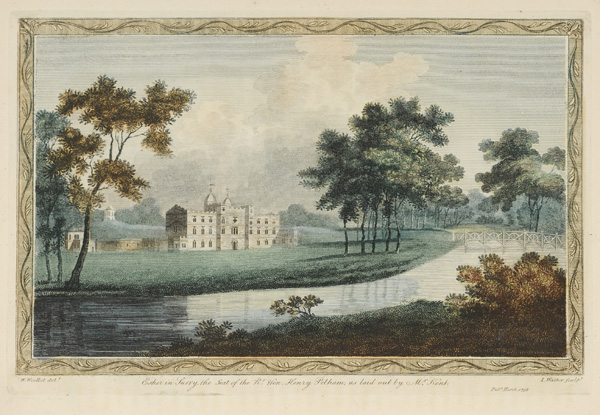
This is a color plate from a book called Observations on Modern Gardening, and Laying Out Pleasure-Grounds, Parks, Ridings, etc. by Horace, Earl of Orford, and ornamented with plates chiefly designed by Mr. Wollet.

This is a German estate (Rastatt Favorite Palace) but it has an English garden.

Stowe Gardens, designed by William Kent.

Two more of Stowe, above and below.

A shrubbery could be open, i.e., planted on one side, or closed, (on both). Of course, the closed kind is far more beneficial for everything secretive your heroine must do on her socially acceptable walk, since the shrubbery will give her ample opportunity to get as close to your hero as you’d like.
The aesthetics of the plantings in the shrubbery were important. Garden books at the time suggested planting various shades of green and flowers that would bloom in succession so that the blooms would always be plentiful. Groupings of plants were preferred to planting flowers at regularly spaced intervals, because the later would look, per Sylvia Florifera, like “beaux and belles standing up for a quadrille or country dance.”

This is a watercolor of Sheringham Hall in Norfolk, designed by the premier landscaper of 18th century England, Sir Humphrey Repton (1752-1818). He considered the landscaping of this estate his finest work.

This is Bramham Park, Yorkshire. The picture shows an example of the English Forest style from the early 1700's, with avenues and extensive plantings of forest trees.
So there you have it, and not a weed in sight. :)
Tuesday, May 31, 2011
In the Garden with Jane Austen: Privies and Ha-Ha Walls
At last, spring has hit Northern Ohio Miami , FL


Okay, those were some shots from my garden. I love flowers!
I'd like to share some things I learned from a beautiful book called In the Garden with Jane Austen by Kim Wilson. This book is essentially a stroll through the kinds of gardens Jane would have known and visited--from cottage gardens, town gardens, public gardens and parks, to gardens of the great estates. It is peppered wtih beautiful photographs, period drawings, biographical information, and exerpts from Jane's novels and letters. Clearly, the author recognized Jane's love of gardens, and marries that to all sorts of wonderful details about the Regency period. Here are just a few fascinating facts I learned. Keep them in mind, Regency writers (or just enjoy them, everyone else):
--"Plucking a rose" meant visiting the privy. (Can you imagine using this expression in your next Regency novel?) Why? Because the "conveniency" or "necessary house" was often located in the very back of the garden (as far away from the house as possible!), so you had to pass by all the flowers to get there. (Might as well pick a few on your way, I reckon.)
--On a great estate, the main pleasure grounds of the house (decoratively planted areas, walks, shrubberies, lawns, gardens, conservatories, hothouses, and temples) were separated from the park (the grounds reserved for timber, deer, cattle and sheep) by a hidden wall called a ha-ha. (Supposedly it was named for the expression of surprise one would utter when accidentally coming upon this drop-off as one was walking around). This clever structure (often made of stone) preserved the view from the house but also created a barrier to keep the livestock off the beautiful main lawn.
I had read of ha-ha walls before, but the way they were described, could never picture them. Wilson's book has a perfect picture of one that is instantly understandable.
You can read more about ha-ha walls here and you can see one below. This pic doesn't really do it justice--the top of the wall should be level with the grass--so the wall is essentially hidden from view. If, for example, you are standing in front of a grand estate looking out over the lawn, you would not see the wall at all.

This is a rather gruesome cartoon (taken from the BBC link above), but it illustrates this hidden wall idea a lot better, IMO:

These interesting but obscure facts don't by any means do this book justice--it's loaded with rich, beautiful pictures of gardens in various settings.
Next post, I'm going to describe exactly what a shrubbery is--and why your heroine is likely to do something illusive, secretive, or even downright shocking in one!
Enjoy the weather!


Okay, those were some shots from my garden. I love flowers!
I'd like to share some things I learned from a beautiful book called In the Garden with Jane Austen by Kim Wilson. This book is essentially a stroll through the kinds of gardens Jane would have known and visited--from cottage gardens, town gardens, public gardens and parks, to gardens of the great estates. It is peppered wtih beautiful photographs, period drawings, biographical information, and exerpts from Jane's novels and letters. Clearly, the author recognized Jane's love of gardens, and marries that to all sorts of wonderful details about the Regency period. Here are just a few fascinating facts I learned. Keep them in mind, Regency writers (or just enjoy them, everyone else):
--"Plucking a rose" meant visiting the privy. (Can you imagine using this expression in your next Regency novel?) Why? Because the "conveniency" or "necessary house" was often located in the very back of the garden (as far away from the house as possible!), so you had to pass by all the flowers to get there. (Might as well pick a few on your way, I reckon.)
--On a great estate, the main pleasure grounds of the house (decoratively planted areas, walks, shrubberies, lawns, gardens, conservatories, hothouses, and temples) were separated from the park (the grounds reserved for timber, deer, cattle and sheep) by a hidden wall called a ha-ha. (Supposedly it was named for the expression of surprise one would utter when accidentally coming upon this drop-off as one was walking around). This clever structure (often made of stone) preserved the view from the house but also created a barrier to keep the livestock off the beautiful main lawn.
I had read of ha-ha walls before, but the way they were described, could never picture them. Wilson's book has a perfect picture of one that is instantly understandable.
You can read more about ha-ha walls here and you can see one below. This pic doesn't really do it justice--the top of the wall should be level with the grass--so the wall is essentially hidden from view. If, for example, you are standing in front of a grand estate looking out over the lawn, you would not see the wall at all.
This is a rather gruesome cartoon (taken from the BBC link above), but it illustrates this hidden wall idea a lot better, IMO:

These interesting but obscure facts don't by any means do this book justice--it's loaded with rich, beautiful pictures of gardens in various settings.
Next post, I'm going to describe exactly what a shrubbery is--and why your heroine is likely to do something illusive, secretive, or even downright shocking in one!
Enjoy the weather!
Thursday, May 19, 2011
Deep POV Tips from Author Jules Bennett
Harlequin Desire author Jules Bennett gave an awesome workshop about deep point of view (POV) for those of us who attended the Cleveland Rocks Romance Conference this past weekend. Jules gave me permission to post her helpful pointers about writing deep POV and ramping up the emotional stakes in your own work:
- Before you begin writing, imagine yourself in your scene. Specifically ask yourself, what am I seeing? What am I smelling? Take a virtual look around and experience the scene through your senses.
- Strive to put an emotional up-and-down in each scene. Just as a scene has a beginning, middle, and an end, so it must also have emotional ups and downs.
- Who’s head to write in? We’ve all heard that we should write the scene from the POV of the character with the most to lose. If you’re having trouble deciding that, jot down a paragraph or two in the heroine’s POV and another paragraph or two in the hero’s, then decide which is most effective.
- To get deep into the minds of your characters, do a quick, five-minute journal entry pretending you are that character. The question you are answering is: how would you feel if this happened in your life? Jules said don’t get carried away with it, do it quickly and briefly and get back to writing.
- Setting often makes a big difference in how the characters act and feel. It needs to come alive, as well as the characters. Jules shared a tip that everyone loved—when she researches different places, she often calls realty agents in the area to ask details like, what are the popular attractions, how do people dress, what are the nightclubs like? Having set a book in
Miami Miami
- You can use your own mood to help your writing. Once she has her rough draft down, Jules hops around when revising depending on her mood. So she tries to channel her current mood, good or bad, into her writing.
- Openings need to be packed with a punch, so work hard on them. A tip from Leanne Banks: before you start a new manuscript, really quickly, list 20 things you want to happen in your book. This is a creative way to explore and focus on what you really want to write about.
- When asked about her process, Jules says she begins with one scene in her head and then keeps asking what if? over and over.

Jules was a very dynamic speaker—comfortable in front of the crowd and also very friendly—and she looked just as sparkly as her website! Her latest book Her Innocence, His Conquest, is a new Harlequin Desire release for April. Read more about Jules at julesbennet.com.
Monday, May 9, 2011
Living With a Difficult Muse
Still consumed with meeting my 1500 words-per-day quota for my Novel in Six Months Class with Lori Wilde at SavvyAuthors, I thought I would share more of my overwhelming frustrations as I continue to learn how to do this!
I wrote over 8,000 words last week, all in a state of pure terror. Every morning, I wonder where six more pages of writing is going to come from. Where does it come from? Did you ever wonder?
My muse is ornery, difficult, and uncooperative. Stubborn, too. She makes my life hell! What to do with her? Is there any way to train a muse?
I wish I was the kind of writer who can follow a schedule. For example, I say, I am going to sit here for four hours and at the end, I'm going to be done. But no! At the end of the time, yes, I do have something, but it sucks, and requires more hours of hairpulling and cursing and pacing all about the house to turn it into something resembling coherence. This is very bad for anyone who has any other responsibilities other than writing. It makes for a cranky, befrazzled person who feels like she can never get her work done.
I think there is a type of writer who is so gifted so as to be a natural plotter--who can envision the most unique twists and turns, who can create sensational high concept ideas. A person like this has a highly creative mind and the vision to carry their ideas out. There is also a writer who makes outlines and sticks to them. Why couldn't I have a muse who works like that?
I am not a natural plotter. I am the wost panster-plotter ever! I sit for hours trying to envision, write down, map, plot out, storyboard what on earth is going to happen next to my poor, tortured characters. Even if I get some semblance of a shoddy outline down, alas, my muse changes drections on me, and it's back to the drawing board again.
I have no problem with sitting here for hours. I've got that part down! But now I have to learn the habits of somone who simply cannot afford to take time for tangents and detours and endless redoings. I've got to learn to move.
Having a background in science, I reflect often on the differences between a life that depends on creative ideas and one that works with "facts." There are more similarities than one would at first imagine, and I'm not really saying the two are mutually exclusive, (and science does require creativity and who said science is made of "facts" anyway?) but all that makes for a different blog post. The biggest difference I can see is that in a writer's life, your brain has to generate the raw material that makes for the rest of your day. It's your imagination that creates what you work on all day.
Sometimes, I wonder if stories are just born to be told in a certain way. Have you ever had this experience--you are rewriting or re-envisioning a scene. Maybe you forgot that you've done it before. Have you ever compared the new scene with the old one? I find that at times the word choices are almost identical. this always scares me in a creepy way. Again I wonder, where exactly do these ideas come from?
I'm hoping this all becomes easier. That if I just keep at it, I will learn. The great joys of writing are always balanced by difficulties, just like everything else on this planet.
In the meantime, anybody want to trade muses?
I wrote over 8,000 words last week, all in a state of pure terror. Every morning, I wonder where six more pages of writing is going to come from. Where does it come from? Did you ever wonder?
My muse is ornery, difficult, and uncooperative. Stubborn, too. She makes my life hell! What to do with her? Is there any way to train a muse?
I wish I was the kind of writer who can follow a schedule. For example, I say, I am going to sit here for four hours and at the end, I'm going to be done. But no! At the end of the time, yes, I do have something, but it sucks, and requires more hours of hairpulling and cursing and pacing all about the house to turn it into something resembling coherence. This is very bad for anyone who has any other responsibilities other than writing. It makes for a cranky, befrazzled person who feels like she can never get her work done.
I think there is a type of writer who is so gifted so as to be a natural plotter--who can envision the most unique twists and turns, who can create sensational high concept ideas. A person like this has a highly creative mind and the vision to carry their ideas out. There is also a writer who makes outlines and sticks to them. Why couldn't I have a muse who works like that?
I am not a natural plotter. I am the wost panster-plotter ever! I sit for hours trying to envision, write down, map, plot out, storyboard what on earth is going to happen next to my poor, tortured characters. Even if I get some semblance of a shoddy outline down, alas, my muse changes drections on me, and it's back to the drawing board again.
I have no problem with sitting here for hours. I've got that part down! But now I have to learn the habits of somone who simply cannot afford to take time for tangents and detours and endless redoings. I've got to learn to move.
Having a background in science, I reflect often on the differences between a life that depends on creative ideas and one that works with "facts." There are more similarities than one would at first imagine, and I'm not really saying the two are mutually exclusive, (and science does require creativity and who said science is made of "facts" anyway?) but all that makes for a different blog post. The biggest difference I can see is that in a writer's life, your brain has to generate the raw material that makes for the rest of your day. It's your imagination that creates what you work on all day.
Sometimes, I wonder if stories are just born to be told in a certain way. Have you ever had this experience--you are rewriting or re-envisioning a scene. Maybe you forgot that you've done it before. Have you ever compared the new scene with the old one? I find that at times the word choices are almost identical. this always scares me in a creepy way. Again I wonder, where exactly do these ideas come from?
I'm hoping this all becomes easier. That if I just keep at it, I will learn. The great joys of writing are always balanced by difficulties, just like everything else on this planet.
In the meantime, anybody want to trade muses?
Subscribe to:
Posts (Atom)