Showing posts with label Regency Period. Show all posts
Monday, September 24, 2012
Fort George, Ontario, in the Eyes of a Regency-Era Writer
To celebrate that I am now a dot-com, I thought would share some pics from my recent trip to Fort George in Niagara-on-the-Lake, Canada.
Of course Mr. Liasson wanted to see the fort. "It's Regency period," he said in a tempting voice. Well, I succumbed, and it was great! Okay, it's not London, but look at what we saw...
Here is the Union Jack flying atop the fort (well, you're only supposed to call it that when it's at sea, so I suppose I should say Union Flag.)
A British Canadian soldier twirling his musket. It weighs 9 pounds, 10 with the bayonet. I got to hold it--it was heavy!
Playing the fife.
Tunnel made of stone.
British officer uniform for the Canadian army is on the left. A New York State Militia Officer's coat is on the right. Both are circa 1812.
A musket, pistols, and a sword artfully displayed on a mantel. I LOVED THIS! Who says army guys aren't artsy!
No trip to Ontario area is complete without a visit to Niagara Falls. This is my artistic effort to capture the power and the intense drop off. (How would you like to be the person whose job it is to pick up that Coke can???)
A fun trip was had by all. (Mr. and Mrs. Liasson, after a happy weekend away :)
Friday, April 15, 2011
Elizabeth Inchbald: A Real-Life Regency Heroine
I am reading a book, Passion and Principle: the Loves and Lives of Regency Women by Jane Aiken Hodge.
Here is an amazing story I rustled up from this book:
Have you ever heard of Elizabeth Inchbald (1753-1821)? She is a woman with an incredibly independent spirit for her age (well, for any age!) who was a novelist, playwright, and actress.
Elizabeth was a farmer's daughter who was never formally educated but read a lot. Her passion was the theater, and she ran away at 17 to London to become an actress, leaving a note of apology for her mother. A few days later, she sought refuge with her married sisters, and her mother forgave her for fleeing. An actor, Joseph Inchbald, who had two illegitimate daughters, pursued her and offered marriage. They were in an acting company together, and performed Shakespeare as well as plays by popular playwrights.
Her marriage was not perfect. In her diaries she recorded that her husband was often jealous and made scenes after his drinking. In her travels, she met the actor and stage manager John Phillip Kemble, worked in one of his plays, and clearly made her husband jealous by her friendship with him. He was her lifelong friend and also apparently her unrequited love, but she denied that they were ever lovers.
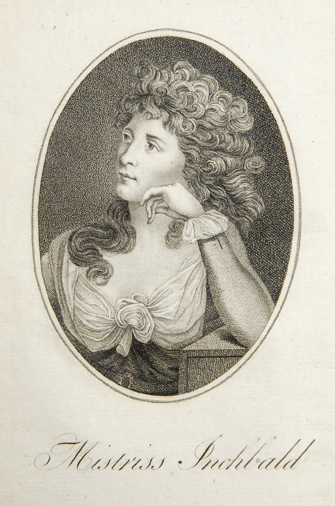
Here are some images of Elizabeth, before I continue on with her story:

In all, Elizabeth wrote over 20 plays. The work she is most well known for is a novel called A Simple Life. Reportedly, she patterned the hero after Kemble. He is handsome, romantic, but unheroic--it is not a flattering portrait.
The theme of A Simple Life is that a proper education is essential for women to make the right choices in life.
Elizabeth continued to live independently on her earnings until her death.
Spunky, intelligent, and independent...now that's a real-life Regency heroine for you!
Sources:
Passion and Principle: the Loves and Lives of Regency Women by Jane Aiken Hodge. John Murray Publishers, London, 1996.
Elizabeth Inchbald, article by Elma Scott, Chawton House Library, viewed at: http://www.chawton.org/library/biographies/inchbald.html
Here is an amazing story I rustled up from this book:
Have you ever heard of Elizabeth Inchbald (1753-1821)? She is a woman with an incredibly independent spirit for her age (well, for any age!) who was a novelist, playwright, and actress.
Elizabeth was a farmer's daughter who was never formally educated but read a lot. Her passion was the theater, and she ran away at 17 to London to become an actress, leaving a note of apology for her mother. A few days later, she sought refuge with her married sisters, and her mother forgave her for fleeing. An actor, Joseph Inchbald, who had two illegitimate daughters, pursued her and offered marriage. They were in an acting company together, and performed Shakespeare as well as plays by popular playwrights.
Her marriage was not perfect. In her diaries she recorded that her husband was often jealous and made scenes after his drinking. In her travels, she met the actor and stage manager John Phillip Kemble, worked in one of his plays, and clearly made her husband jealous by her friendship with him. He was her lifelong friend and also apparently her unrequited love, but she denied that they were ever lovers.
Here are some images of Elizabeth, before I continue on with her story:

Suddenly widowed in 1779, Elizabeth decided to continue to act while she pursued writing. She used her stage salary as security. Although she had multiple offers of marriage, she refused them all, preferring her independence. A novel she wrote was rejected, as were several plays, but she had great success at last with the play A Mogul's Tale in 1784. "There is no woman I more truly admire, nor any man whose abilities I more highly esteem," wrote John Kemble, who did not offer marraige as Elizabeth must have hoped. The author William Godwin, husband of Mary Wollstonecraft, was, however, one of the men who did propose marriage, but she declined.
In all, Elizabeth wrote over 20 plays. The work she is most well known for is a novel called A Simple Life. Reportedly, she patterned the hero after Kemble. He is handsome, romantic, but unheroic--it is not a flattering portrait.
The theme of A Simple Life is that a proper education is essential for women to make the right choices in life.
Elizabeth continued to live independently on her earnings until her death.
Spunky, intelligent, and independent...now that's a real-life Regency heroine for you!
Sources:
Passion and Principle: the Loves and Lives of Regency Women by Jane Aiken Hodge. John Murray Publishers, London, 1996.
Elizabeth Inchbald, article by Elma Scott, Chawton House Library, viewed at: http://www.chawton.org/library/biographies/inchbald.html
Subscribe to:
Posts (Atom)