A few days ago, I finished the first draft of a novel I began writing in April under the tutelage of Lori Wilde in her Novel in Six Months Class at SavvyAuthors. It came in at around 77,000 words. Now mentally exhausted and physically drained, I took the entire weekend off to reboot my weary self. Four romantic comedies and one Jane Austenesque book later, I found myself (as I sipped cold sparkling water in my back yard while reclining with aforementioned book) becoming introspective about the crazy life writers lead.
--Writing the climax of this book-in-progess of mine was the most agonizing thing I have ever done. I could not sleep until I got my hero and heroine out of crisis and tucked safely into their happily-ever-after. It took about a week for me to navigate those tricky scenes and I was mentally and physically affected. An example: my daughter asked me a question while I was furiously typing away and I mumbled an answer...and then she asked, "Mom, why did you just answer me in a British accent?!" The characters in my head were coming out to torment the rest of my life!
--Author Steve Berry, when he spoke at RWA in NYC earlier this summer, said something really interesting. He said (and this is from scrawls in my little notebook--so it's a paraphrase)--Every writer he's ever known has a little voice in their head. I have known about my little voice for quite some time now. But this was a revelation! Someone was actually admitting this out loud! On observing someone or something, the voice says particular things like, she cast her weary eyes downward or her skirt pouffed out like a skein of cotton candy at the most unexpected times. What a relief to know that others hear The Voice, too!
--What caused all this reflection was a passage in the book I am currently reading, A Weekend with Mr. Darcy by Victoria Connelly. The book is about an English professor who's secret passion is reading Regency romance novels, especially ones by a particular favorite author. (You can read more about this charming book here--this review made me instantly download the book.) Anyway, the author character in the book makes this revelatory comment about writers (here's a bit of a setup before the comment for context):
"Warwick watched her as she looked around the hall, tiny white teeth biting her lower lip, and a part of him wanted to go help her--to take her bag and say, 'Come this way,' but the writer in him stayed perfectly still and watched.
That was one of the things about being a writer--one always stood slightly apart, listening and watching. It was hard to tell sometimes, if one were really alive, for life seemd to be happening to everybody else, and yet the writer's lot seemed to be one of permanent stillness. Had Jane Austen felt like that? he wondered."
So, do you get emotionally involved with imaginary people in your head? Have difficulties with the voice that rambles around in there at the most inappropriate times? Or find yourself observing and imbibing the details of life, sort of voyeuristically? You may not need Haldol after all...you just might be a Writer.

Showing posts with label All Things Jane. Show all posts
Showing posts with label All Things Jane. Show all posts
Sunday, July 31, 2011


Monday, June 6, 2011
In the Garden with Jane Austen: Part 2, The Shrubbery
I promised to take you on a tour of an English shrubbery, as Kim Wilson describes it in her beautiful book In the Garden with Jane Austen. (Please see my last post if you want more information about the book.)

The English garden was built to be experienced by walking through it and discovering surprising elements--vistas, benches, follies, grottoes, etc.
The English garden was built to be experienced by walking through it and discovering surprising elements--vistas, benches, follies, grottoes, etc.
For now, just imagine that you are a Regency heroine, and you are spending time at your family’s great country estate. You’d like the health benefits of a daily constitutional, but it’s rained recently and the countryside has turned into a muddy quagmire (channel Keira Knightly as Elizabeth trapsing through the mud to see her sick sister Jane at Bingley’s estate) You don’t dare get wet, knowing that wet feet could kill a person, especially a woman with her flimsy shoes and (arguably) more fragile constitution. What to do?

Garden path in a Regency shrubbery.
Well, the architect of your estate has done something just for you. He (she?—I hope there were some “she” architects) has created for you the shrubbery, that fantastic, carefully arranged walk that will lead you through a variety of carefully arranged gardens, trees, shrubs, all with quick-draining gravel and long enough for you to get some real exercise. (It was a great relief for me to learn that there actually was “gravel” back then. I get tired of writing about cobblestones. :) )
These walks were sometimes wide enough to accommodate three people astride. Wilson Elizabeth
“...each walk should lead to a particular Object; to the orchard, kitchen garden, botanical borders, green-house, dairy, ice-house, mushroom-hut, aviary, poultry-yard, or stables. The intention of the plantation should seem to be, to conduct the walker in the most agreeable manner to each outlet and building of utility or pleasure.”

Look how extensive the original plan of Stowe Garden (Buckinghamshire, England) was in 1739.

This is a color plate from a book called Observations on Modern Gardening, and Laying Out Pleasure-Grounds, Parks, Ridings, etc. by Horace, Earl of Orford, and ornamented with plates chiefly designed by Mr. Wollet.

This is a German estate (Rastatt Favorite Palace) but it has an English garden.

Stowe Gardens, designed by William Kent.

Two more of Stowe, above and below.

A shrubbery could be open, i.e., planted on one side, or closed, (on both). Of course, the closed kind is far more beneficial for everything secretive your heroine must do on her socially acceptable walk, since the shrubbery will give her ample opportunity to get as close to your hero as you’d like.
The aesthetics of the plantings in the shrubbery were important. Garden books at the time suggested planting various shades of green and flowers that would bloom in succession so that the blooms would always be plentiful. Groupings of plants were preferred to planting flowers at regularly spaced intervals, because the later would look, per Sylvia Florifera, like “beaux and belles standing up for a quadrille or country dance.”

This is a watercolor of Sheringham Hall in Norfolk, designed by the premier landscaper of 18th century England, Sir Humphrey Repton (1752-1818). He considered the landscaping of this estate his finest work.

This is Bramham Park, Yorkshire. The picture shows an example of the English Forest style from the early 1700's, with avenues and extensive plantings of forest trees.
So there you have it, and not a weed in sight. :)
Tuesday, May 31, 2011
In the Garden with Jane Austen: Privies and Ha-Ha Walls
At last, spring has hit Northern Ohio Miami , FL


Okay, those were some shots from my garden. I love flowers!
I'd like to share some things I learned from a beautiful book called In the Garden with Jane Austen by Kim Wilson. This book is essentially a stroll through the kinds of gardens Jane would have known and visited--from cottage gardens, town gardens, public gardens and parks, to gardens of the great estates. It is peppered wtih beautiful photographs, period drawings, biographical information, and exerpts from Jane's novels and letters. Clearly, the author recognized Jane's love of gardens, and marries that to all sorts of wonderful details about the Regency period. Here are just a few fascinating facts I learned. Keep them in mind, Regency writers (or just enjoy them, everyone else):
--"Plucking a rose" meant visiting the privy. (Can you imagine using this expression in your next Regency novel?) Why? Because the "conveniency" or "necessary house" was often located in the very back of the garden (as far away from the house as possible!), so you had to pass by all the flowers to get there. (Might as well pick a few on your way, I reckon.)
--On a great estate, the main pleasure grounds of the house (decoratively planted areas, walks, shrubberies, lawns, gardens, conservatories, hothouses, and temples) were separated from the park (the grounds reserved for timber, deer, cattle and sheep) by a hidden wall called a ha-ha. (Supposedly it was named for the expression of surprise one would utter when accidentally coming upon this drop-off as one was walking around). This clever structure (often made of stone) preserved the view from the house but also created a barrier to keep the livestock off the beautiful main lawn.
I had read of ha-ha walls before, but the way they were described, could never picture them. Wilson's book has a perfect picture of one that is instantly understandable.
You can read more about ha-ha walls here and you can see one below. This pic doesn't really do it justice--the top of the wall should be level with the grass--so the wall is essentially hidden from view. If, for example, you are standing in front of a grand estate looking out over the lawn, you would not see the wall at all.

This is a rather gruesome cartoon (taken from the BBC link above), but it illustrates this hidden wall idea a lot better, IMO:

These interesting but obscure facts don't by any means do this book justice--it's loaded with rich, beautiful pictures of gardens in various settings.
Next post, I'm going to describe exactly what a shrubbery is--and why your heroine is likely to do something illusive, secretive, or even downright shocking in one!
Enjoy the weather!


Okay, those were some shots from my garden. I love flowers!
I'd like to share some things I learned from a beautiful book called In the Garden with Jane Austen by Kim Wilson. This book is essentially a stroll through the kinds of gardens Jane would have known and visited--from cottage gardens, town gardens, public gardens and parks, to gardens of the great estates. It is peppered wtih beautiful photographs, period drawings, biographical information, and exerpts from Jane's novels and letters. Clearly, the author recognized Jane's love of gardens, and marries that to all sorts of wonderful details about the Regency period. Here are just a few fascinating facts I learned. Keep them in mind, Regency writers (or just enjoy them, everyone else):
--"Plucking a rose" meant visiting the privy. (Can you imagine using this expression in your next Regency novel?) Why? Because the "conveniency" or "necessary house" was often located in the very back of the garden (as far away from the house as possible!), so you had to pass by all the flowers to get there. (Might as well pick a few on your way, I reckon.)
--On a great estate, the main pleasure grounds of the house (decoratively planted areas, walks, shrubberies, lawns, gardens, conservatories, hothouses, and temples) were separated from the park (the grounds reserved for timber, deer, cattle and sheep) by a hidden wall called a ha-ha. (Supposedly it was named for the expression of surprise one would utter when accidentally coming upon this drop-off as one was walking around). This clever structure (often made of stone) preserved the view from the house but also created a barrier to keep the livestock off the beautiful main lawn.
I had read of ha-ha walls before, but the way they were described, could never picture them. Wilson's book has a perfect picture of one that is instantly understandable.
You can read more about ha-ha walls here and you can see one below. This pic doesn't really do it justice--the top of the wall should be level with the grass--so the wall is essentially hidden from view. If, for example, you are standing in front of a grand estate looking out over the lawn, you would not see the wall at all.
This is a rather gruesome cartoon (taken from the BBC link above), but it illustrates this hidden wall idea a lot better, IMO:

These interesting but obscure facts don't by any means do this book justice--it's loaded with rich, beautiful pictures of gardens in various settings.
Next post, I'm going to describe exactly what a shrubbery is--and why your heroine is likely to do something illusive, secretive, or even downright shocking in one!
Enjoy the weather!
Wednesday, February 16, 2011
Two Darcys, Two Proposals
I have a line in my short story for the Jane Austen Made Me Do It Short Story Contest that harkens back to Darcy's second proposal in Pride and Prejudice. My line, spoken by a very contemporary British man, the hero (so to speak) of my story, is: "I can't stop thinking about you. But one word from you and I'll be silent--forever."
I thought it would be fun to compare the original text of Pride and Prejudice to what is spoken in the 2005 movie version, when Matthew MacFayden as Darcy proposes to Keira Knightley's Elizabeth.
(People tend to be very passionate about what movie version of Pride and Prejudice they like best. So if you are not a fan of this version, please bear with me.)
Here are Darcy's words, spoken by Matthew MacFayden, as he proposes the first time, in the temple of Apollo at Stourhead estate in Wiltshire (it's gorgeous--see pic at right):
"Miss Elizabeth, I have struggled in vain and I can bear it no longer. These last months have been a torment. I came to Rosings for the single object of seeing you. I had to see you. I fought against my better judgment, my family's expectation, the inferiority of your birth, my rank and circumstance, all these things, and I am willing to put them all aside and ask you to end my agony.
I love you--most ardently. Please do me the honor of accepting my hand."
And here are Darcy's words, from the book:
"In vain have I struggled. It will not do. My feelings will not be repressed. You must allow me to tell you how ardently I admire and love you."
The other sentiments expressed, about the inferiority of her birth, etc., as well as the actual proposal, are not given in dialogue.
Now, let's look at the second proposal. Here are Matthew MacFayden's words from the movie:
"My affections and wishes have not changed, but one word from you will silence me forever.
If, however, your feelings have changed, I would have to tell you, you have bewitched me body and soul and I love--I love--I love you, and never wish to be parted from you from this day on."
And Darcy's actual words from the book:
"You are too generous to trifle with me. If your feelings are still what they were last April, tell me so at once. My affections and wishes are unchanged, but one word from you will silence me on this subject forever."
These comparisons bring up all kinds of thoughts--from how novels were written 200 years ago to dramatic license of screenwriters to the immediacy of dialogue, to showing vs. telling.
Which version gives you chills?
I thought it would be fun to compare the original text of Pride and Prejudice to what is spoken in the 2005 movie version, when Matthew MacFayden as Darcy proposes to Keira Knightley's Elizabeth.
(People tend to be very passionate about what movie version of Pride and Prejudice they like best. So if you are not a fan of this version, please bear with me.)
Here are Darcy's words, spoken by Matthew MacFayden, as he proposes the first time, in the temple of Apollo at Stourhead estate in Wiltshire (it's gorgeous--see pic at right):
"Miss Elizabeth, I have struggled in vain and I can bear it no longer. These last months have been a torment. I came to Rosings for the single object of seeing you. I had to see you. I fought against my better judgment, my family's expectation, the inferiority of your birth, my rank and circumstance, all these things, and I am willing to put them all aside and ask you to end my agony.
I love you--most ardently. Please do me the honor of accepting my hand."
And here are Darcy's words, from the book:
"In vain have I struggled. It will not do. My feelings will not be repressed. You must allow me to tell you how ardently I admire and love you."
The other sentiments expressed, about the inferiority of her birth, etc., as well as the actual proposal, are not given in dialogue.
Now, let's look at the second proposal. Here are Matthew MacFayden's words from the movie:
"My affections and wishes have not changed, but one word from you will silence me forever.
If, however, your feelings have changed, I would have to tell you, you have bewitched me body and soul and I love--I love--I love you, and never wish to be parted from you from this day on."
And Darcy's actual words from the book:
"You are too generous to trifle with me. If your feelings are still what they were last April, tell me so at once. My affections and wishes are unchanged, but one word from you will silence me on this subject forever."
These comparisons bring up all kinds of thoughts--from how novels were written 200 years ago to dramatic license of screenwriters to the immediacy of dialogue, to showing vs. telling.
Which version gives you chills?
Monday, February 14, 2011
Portraits of Jane Austen
In my short story, The Lost Portrait of Jane Austen, I imagined that an artist painted her a proper portrait. But in real life, Jane Austen never sat for a formal portrait. (In her family of 5 brothers and 1sister, all her brothers except her handicapped brother George had formal portraits. Cassandra had a silhouette done. This definitely reflects the place of women in those times, doesn't it?)
Jane's sister Cassandra did the famous pencil and watercolor sketch of her, below, around 1810 (Jane would have been 34 or 35). It now resides in the National Portrait Gallery in London. According to Jane biographer Claire Tomalin, this sketch was regarded as "inadequate and unflattering" by those who knew her. But it is the only image we have of her that has been drawn from life. People who knew Jane described Jane as having hazel eyes, round cheeks with high color, and curly hair.

This unfinished sketch spawned every other portrait that has ever been painted of Jane.
A more flattering portrait based off of this sketch was commissioned by her family by a Mr. Andrews of Maidenhead, 1869, that is still owned by her family. (For reference, Jane died in 1817, so this was commissioned many years after her death.):

And here is a 1869 engraving, based off Mr. Andrews watercolor, used on the 1870 A Memoir of Jane Austen by her nephew Edward Austen-Leigh:

Here's one, based off the above engraving, which appeared on her biography by GE Mitton, 1905:

And then there's this one, called a "more sentimentalized Victorian version" of the above portrait:

This silhouette is owned by the National Portrait Gallery and was found in an old edition of Mansfield Park and inscribed with the words "L'aimable Jane.'"

This pencil and watercolor sketch was found in the Prince Regent's librarian, Rev. James Stanier Clarke's so called "Friendship Book," a personal album he kept of over a hundred drawings, verses, and autographs. It is speculated to possibly be of Jane from the time she was invited to view the Prince Regent's library in 1815. The book itself was sold at an estate sale to a used book dealer, and discovered in his shop in 1955. You can read a scholarly article about it here.

Jane's sister Cassandra did the famous pencil and watercolor sketch of her, below, around 1810 (Jane would have been 34 or 35). It now resides in the National Portrait Gallery in London. According to Jane biographer Claire Tomalin, this sketch was regarded as "inadequate and unflattering" by those who knew her. But it is the only image we have of her that has been drawn from life. People who knew Jane described Jane as having hazel eyes, round cheeks with high color, and curly hair.
This unfinished sketch spawned every other portrait that has ever been painted of Jane.
A more flattering portrait based off of this sketch was commissioned by her family by a Mr. Andrews of Maidenhead, 1869, that is still owned by her family. (For reference, Jane died in 1817, so this was commissioned many years after her death.):

And here is a 1869 engraving, based off Mr. Andrews watercolor, used on the 1870 A Memoir of Jane Austen by her nephew Edward Austen-Leigh:
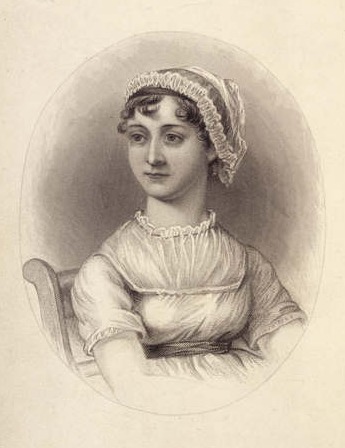
Here's one, based off the above engraving, which appeared on her biography by GE Mitton, 1905:
And then there's this one, called a "more sentimentalized Victorian version" of the above portrait:
This silhouette is owned by the National Portrait Gallery and was found in an old edition of Mansfield Park and inscribed with the words "L'aimable Jane.'"
This pencil and watercolor sketch was found in the Prince Regent's librarian, Rev. James Stanier Clarke's so called "Friendship Book," a personal album he kept of over a hundred drawings, verses, and autographs. It is speculated to possibly be of Jane from the time she was invited to view the Prince Regent's library in 1815. The book itself was sold at an estate sale to a used book dealer, and discovered in his shop in 1955. You can read a scholarly article about it here.
And there you have it. Makes you appreciate digital photography, doesn't it!!!
If you're interested, see more information at The Jane Austen Society of Australia, Pemberley.com, and the National Portrait Gallery.
Subscribe to:
Posts (Atom)